
GD32F470入门教程(六)定时器

19k 词

TIMER

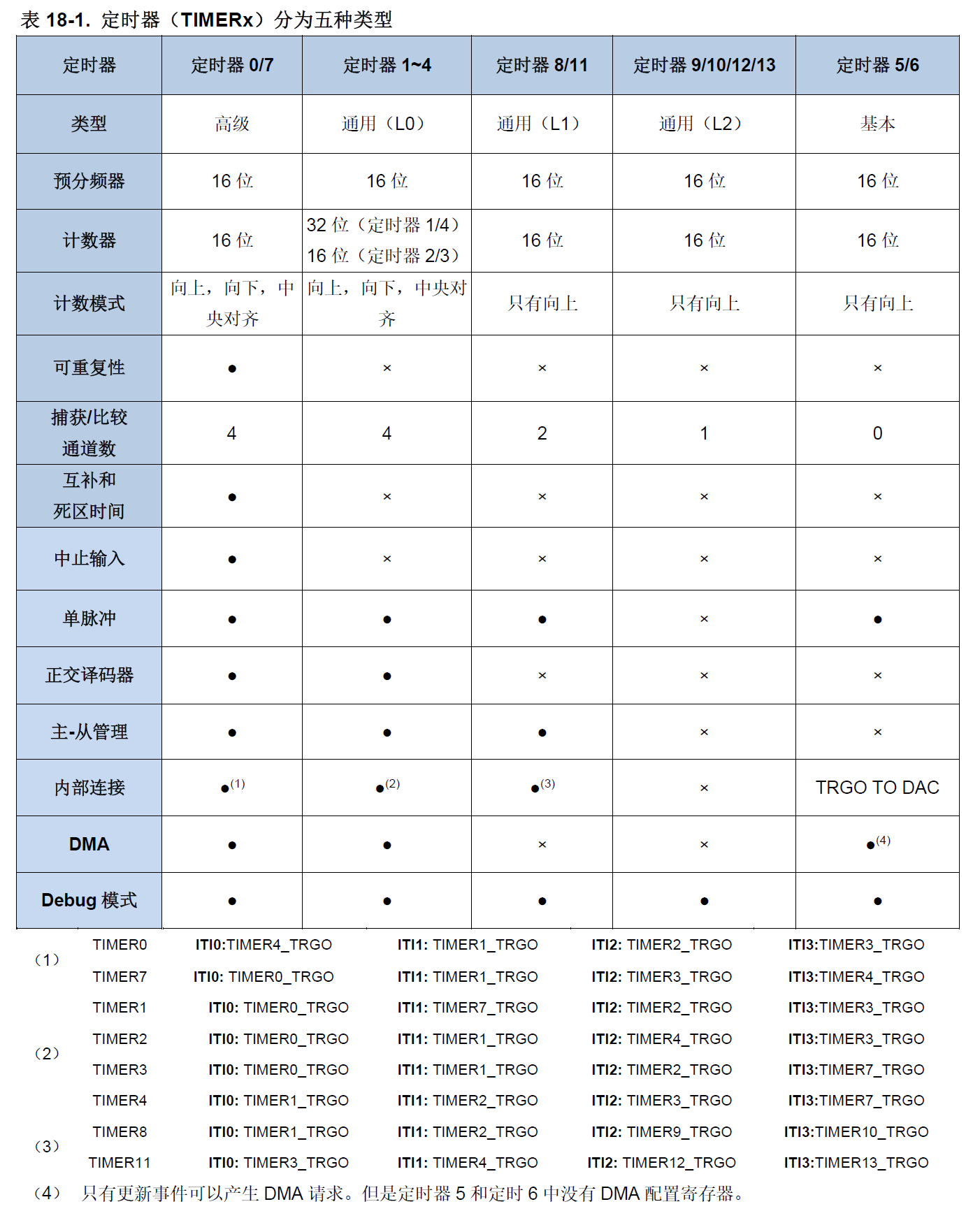
GD32F470定时器介绍

image-20260221104850047

时钟设置

从数据手册中,我们可以找到时钟树

image-20260221155541371

这里我们可以清楚的看到TIMERx在APB1和APB2都被挂载,拿挂载到APB1上的定时器来说,从AHB总线来的频率经过APB1的分频器分频(60MHz max),之后到倍频器进行倍频(240MHz max),最终接到定时器,所以我们想要使用这部分定时器的话,我们需要配置RCC(Reset and Clock Control)来启用定时器的时钟。

在GD32F470的库函数中,我们使用rcu_periph_clock_enable()函数来启用外设时钟。对于定时器,例如TIMER0(挂载在APB1上),我们需要调用:

1
rcu_periph_clock_enable(RCU_TIMER0);

类似地,对于其他定时器,根据其挂载的总线选择相应的RCU宏。

定时器中断使用示例

下面我们以一个简单的定时器中断为例,演示如何使用GD32F470的库函数来配置和使用定时器。我们将使用TIMER0,每隔1秒产生一次中断,并在中断中翻转一个LED。这个示例将一步一步详细说明整个过程。

步骤1:初始化定时器

首先,我们需要初始化定时器。这包括启用定时器的时钟、配置定时器参数、启用中断和配置NVIC。

1
2
3
4
5
6
7
8
9
10
11
12
13
14
15
16
17
18
19
20
21
22
23
24
25
26
27
28
29
#include "gd32f4xx.h"
#include "gd32f4xx_timer.h"

// 定时器初始化函数
void timer_init_example(void) {
timer_parameter_struct timer_initpara;

// 启用TIMER0时钟
rcu_periph_clock_enable(RCU_TIMER0);

// 配置定时器参数
timer_initpara.prescaler = 23999; // 预分频器,系统时钟240MHz,分频到10kHz
timer_initpara.alignedmode = TIMER_COUNTER_EDGE;
timer_initpara.counterdirection = TIMER_COUNTER_UP;
timer_initpara.period = 9999; // 周期,10kHz下9999+1=10000个计数,即1秒
timer_initpara.clockdivision = TIMER_CKDIV_DIV1;
timer_initpara.repetitioncounter = 0;

timer_init(TIMER0, &timer_initpara);

// 启用定时器更新中断
timer_interrupt_enable(TIMER0, TIMER_INT_UP);

// 配置NVIC
nvic_irq_enable(TIMER0_UP_TIMER9_IRQn, 0, 0);

// 启动定时器
timer_enable(TIMER0);
}

在这个步骤中:

  • rcu_periph_clock_enable(RCU_TIMER0);:启用TIMER0的外设时钟,这是使用任何外设的第一步。
  • 配置timer_parameter_struct结构体:设置预分频器(prescaler)来降低时钟频率,设置计数模式为向上计数,设置周期(period)来决定中断间隔。
  • timer_init(TIMER0, &timer_initpara);:使用配置的参数初始化定时器。
  • timer_interrupt_enable(TIMER0, TIMER_INT_UP);:启用定时器的更新中断,当计数器溢出时会触发中断。
  • nvic_irq_enable(TIMER0_UP_TIMER9_IRQn, 0, 0);:在NVIC中启用中断,设置优先级。
  • timer_enable(TIMER0);:启动定时器,开始计数。

步骤2:中断服务函数

当定时器计数到设定的周期时,会触发更新中断。我们需要在中断服务函数中处理这个中断。

1
2
3
4
5
6
7
8
9
// 中断服务函数
void TIMER0_UP_TIMER9_IRQHandler(void) {
if(timer_interrupt_flag_get(TIMER0, TIMER_INT_FLAG_UP) != RESET) {
timer_interrupt_flag_clear(TIMER0, TIMER_INT_FLAG_UP);

// 翻转LED
gpio_bit_toggle(GPIOC, GPIO_PIN_13); // 假设LED连接到PC13
}
}

在这个函数中:

  • 首先检查中断标志位是否置位,以确认是更新中断。
  • 清除中断标志位,这是必须的,否则中断会一直触发。
  • 执行用户代码,这里是翻转LED的状态。

步骤3:在主函数中调用

在main函数中调用初始化函数:

1
2
3
4
5
6
7
8
9
10
11
12
13
14
15
16
int main(void) {
// 系统时钟初始化(这里省略,假设已经配置好240MHz)
// ...

// GPIO初始化(LED引脚)
rcu_periph_clock_enable(RCU_GPIOC);
gpio_mode_set(GPIOC, GPIO_MODE_OUTPUT, GPIO_PUPD_NONE, GPIO_PIN_13);
gpio_output_options_set(GPIOC, GPIO_OTYPE_PP, GPIO_OSPEED_50MHZ, GPIO_PIN_13);

// 定时器初始化
timer_init_example();

while(1) {
// 主循环
}
}

在这个步骤中:

  • 初始化系统时钟(通常在系统启动时完成)。
  • 配置GPIO:启用GPIOC时钟,设置PC13为输出模式,用于控制LED。
  • 调用timer_init_example();来初始化定时器。
  • 主循环中可以放置其他任务,定时器中断会独立运行。

PWM输出使用示例

PWM(Pulse Width Modulation,脉冲宽度调制)是一种通过调节脉冲宽度来控制输出功率的技术。在GD32F470中,定时器可以生成PWM信号,用于控制LED亮度、电机速度等。这个示例将演示如何使用TIMER0的通道0生成PWM信号来控制LED的亮度,实现呼吸灯效果。

PWM基本原理

PWM信号是一个周期性的方波,通过改变高电平持续时间(占空比)来控制平均输出功率。占空比 = (高电平时间 / 周期) * 100%。在定时器中,PWM是通过输出比较功能实现的:当计数器值小于比较值时,输出高电平;当大于时,输出低电平。

步骤1:初始化定时器和PWM通道

首先,我们需要初始化定时器并配置PWM输出通道。

1
2
3
4
5
6
7
8
9
10
11
12
13
14
15
16
17
18
19
20
21
22
23
24
25
26
27
28
29
30
31
32
33
34
35
36
37
38
39
40
41
42
43
44
45
#include "gd32f4xx.h"
#include "gd32f4xx_timer.h"

// PWM初始化函数
void pwm_init_example(void) {
timer_oc_parameter_struct timer_ocinitpara;
timer_parameter_struct timer_initpara;

// 启用TIMER0时钟
rcu_periph_clock_enable(RCU_TIMER0);

// 配置定时器参数
timer_initpara.prescaler = 239; // 预分频器,系统时钟240MHz,分频到1MHz
timer_initpara.alignedmode = TIMER_COUNTER_EDGE;
timer_initpara.counterdirection = TIMER_COUNTER_UP;
timer_initpara.period = 999; // 周期,1MHz下1000个计数,即1kHz PWM频率
timer_initpara.clockdivision = TIMER_CKDIV_DIV1;
timer_initpara.repetitioncounter = 0;

timer_init(TIMER0, &timer_initpara);

// 配置输出比较参数(PWM模式)
timer_ocinitpara.outputstate = TIMER_CCX_ENABLE;
timer_ocinitpara.outputnstate = TIMER_CCXN_DISABLE;
timer_ocinitpara.ocpolarity = TIMER_OC_POLARITY_HIGH;
timer_ocinitpara.ocnpolarity = TIMER_OCN_POLARITY_HIGH;
timer_ocinitpara.ocidlestate = TIMER_OC_IDLE_STATE_LOW;
timer_ocinitpara.ocnidlestate = TIMER_OCN_IDLE_STATE_LOW;

// 设置PWM模式1(在向上计数时,CNT < CCR时输出高电平)
timer_channel_output_mode_config(TIMER0, TIMER_CH_0, TIMER_OC_MODE_PWM1);
timer_channel_output_config(TIMER0, TIMER_CH_0, &timer_ocinitpara);

// 设置初始占空比为50% (500/1000)
timer_channel_output_pulse_value_config(TIMER0, TIMER_CH_0, 500);

// 启用TIMER0的CH0输出
timer_channel_output_state_config(TIMER0, TIMER_CH_0, TIMER_CCX_ENABLE);

// 启用TIMER0的主输出
timer_primary_output_config(TIMER0, ENABLE);

// 启动定时器
timer_enable(TIMER0);
}

在这个步骤中:

  • rcu_periph_clock_enable(RCU_TIMER0);:启用TIMER0的外设时钟。
  • 配置timer_parameter_struct:设置预分频器和周期来确定PWM频率。这里设置为1kHz。
  • 配置timer_oc_parameter_struct:设置输出比较参数,包括输出状态、极性等。
  • timer_channel_output_mode_config(TIMER0, TIMER_CH_0, TIMER_OC_MODE_PWM1);:将通道0设置为PWM模式1。
  • timer_channel_output_config(TIMER0, TIMER_CH_0, &timer_ocinitpara);:应用输出比较配置。
  • timer_channel_output_pulse_value_config(TIMER0, TIMER_CH_0, 500);:设置比较值,决定占空比。
  • 启用通道输出和主输出,然后启动定时器。

步骤2:配置GPIO引脚

PWM信号需要通过特定的GPIO引脚输出,我们需要将GPIO配置为复用功能。

1
2
3
4
5
6
7
8
9
10
11
12
// GPIO配置函数
void gpio_config_example(void) {
// 启用GPIOA时钟
rcu_periph_clock_enable(RCU_GPIOA);

// 配置PA8为复用功能(TIMER0_CH0)
gpio_mode_set(GPIOA, GPIO_MODE_AF, GPIO_PUPD_NONE, GPIO_PIN_8);
gpio_output_options_set(GPIOA, GPIO_OTYPE_PP, GPIO_OSPEED_50MHZ, GPIO_PIN_8);

// 设置PA8的复用功能为TIMER0
gpio_af_set(GPIOA, GPIO_AF_1, GPIO_PIN_8);
}

在这个步骤中:

  • rcu_periph_clock_enable(RCU_GPIOA);:启用GPIOA时钟。
  • gpio_mode_set(GPIOA, GPIO_MODE_AF, GPIO_PUPD_NONE, GPIO_PIN_8);:将PA8设置为复用功能模式。
  • gpio_output_options_set(GPIOA, GPIO_OTYPE_PP, GPIO_OSPEED_50MHZ, GPIO_PIN_8);:设置输出选项。
  • gpio_af_set(GPIOA, GPIO_AF_1, GPIO_PIN_8);:将PA8的复用功能设置为TIMER0(AF1)。

步骤3:在主函数中使用PWM

在main函数中初始化PWM和GPIO,并演示如何动态改变占空比。

1
2
3
4
5
6
7
8
9
10
11
12
13
14
15
16
17
18
19
20
21
22
23
24
25
26
27
28
29
30
31
32
33
34
35
36
37
#include "gd32f4xx.h"
#include <stdint.h>

int main(void) {
uint16_t duty_cycle = 0;
int8_t direction = 1;

// 系统时钟初始化(这里省略,假设已经配置好240MHz)
// ...

// 配置GPIO
gpio_config_example();

// 初始化PWM
pwm_init_example();

while(1) {
// 改变占空比,实现呼吸灯效果
timer_channel_output_pulse_value_config(TIMER0, TIMER_CH_0, duty_cycle);

// 更新占空比
if(direction == 1) {
duty_cycle += 10;
if(duty_cycle >= 1000) {
direction = -1;
}
} else {
duty_cycle -= 10;
if(duty_cycle <= 0) {
direction = 1;
}
}

// 延时一段时间
for(volatile uint32_t i = 0; i < 100000; i++);
}
}

在这个步骤中:

  • 初始化系统时钟(通常在系统启动时完成)。
  • 调用gpio_config_example();配置GPIO引脚。
  • 调用pwm_init_example();初始化PWM。
  • 在主循环中,通过timer_channel_output_pulse_value_config()动态改变占空比,实现LED亮度渐变(呼吸灯效果)。
  • 使用简单的延时循环来控制变化速度。

通过这个示例,你可以学习到如何在GD32F470上使用定时器生成PWM信号。PWM在嵌入式系统中有着广泛的应用,如LED调光、电机控制、音频输出等。你可以根据实际需求调整PWM频率和占空比。

TIMER相关库函数

image-20260221165304897

1. TIMER 相关参数结构体

库函数中定义了多个结构体,用于在初始化时一次性配置多个参数。

timer_parameter_struct(基本配置)

1
2
3
4
5
6
7
8
typedef struct {
uint16_t prescaler; // 预分频值 (0 ~ 65535)
uint16_t alignedmode; // 对齐模式 (边缘对齐、中心对齐模式 0/1/2)
uint16_t counterdirection; // 计数方向 (向上计数、向下计数)
uint32_t period; // 自动重装载值 (周期值)
uint16_t clockdivision; // 时钟分频因数 (用于死区时间和滤波器)
uint8_t repetitioncounter; // 重复计数器值 (仅高级定时器)
} timer_parameter_struct;

timer_oc_parameter_struct(输出比较)

1
2
3
4
5
6
7
8
typedef struct {
uint16_t outputstate; // 输出状态 (使能/禁用)
uint16_t outputnstate; // 互补输出状态 (仅高级定时器)
uint16_t ocpolarity; // 输出极性 (高电平有效/低电平有效)
uint16_t ocnpolarity; // 互补输出极性 (仅高级定时器)
uint16_t ocidlestate; // 空闲状态下通道输出电平
uint16_t ocnidlestate; // 空闲状态下互补通道输出电平
} timer_oc_parameter_struct;

timer_ic_parameter_struct(输入捕获)

1
2
3
4
5
6
typedef struct {
uint16_t icpolarity; // 输入捕获极性 (上升沿、下降沿、双边沿)
uint16_t icselection; // 输入捕获源选择 (直连、非直连、TRC)
uint16_t icprescaler; // 输入捕获分频器
uint16_t icfilter; // 输入捕获滤波器 (0x0 ~ 0xF)
} timer_ic_parameter_struct;

timer_break_parameter_struct(刹车/死区)

1
2
3
4
5
6
7
8
typedef struct {
uint16_t runoffstate; // 运行模式下关闭状态使能/禁用
uint16_t idlestate; // 空闲模式下关闭状态使能/禁用
uint16_t deadtime; // 死区时间配置 (0 ~ 255)
uint16_t breakpolarity; // 刹车信号极性
uint16_t breakstate; // 刹车功能使能/禁用
uint16_t outauto; // 自动输出使能/禁用
} timer_break_parameter_struct;

2. TIMER 重要枚举与宏定义

以下宏定义常用于配置函数的参数选择:

  • 对齐模式TIMER_COUNTER_EDGE (边缘), TIMER_COUNTER_CENTER0/1/2 (中心对齐 0/1/2)
  • 计数方向TIMER_COUNTER_UP (向上计数), TIMER_COUNTER_DOWN (向下计数)
  • 时钟分频系数TIMER_CKDIV_DIV1/2/4
  • 输出比较模式TIMER_OC_MODE_PWM0/1, TIMER_OC_MODE_TOGGLE, TIMER_OC_MODE_ACTIVE
  • 通道选择TIMER_CH_0 ~ TIMER_CH_3
  • 中断源TIMER_INT_UP (更新), TIMER_INT_CH0/1/2/3 (通道), TIMER_INT_BRK (刹车), TIMER_INT_TRG (触发)
  • DMA触发源TIMER_DMA_UPD, TIMER_DMA_CH0/1/2/3

3. 定时器基础配置函数

timer_deinit

函数原型:

1
void timer_deinit(uint32_t timer_periph);

功能描述:
将指定的TIMER重置为默认状态,所有寄存器恢复到复位值。

参数:

  • timer_periph: TIMER外设(TIMER0, TIMER1等)。

返回值:

示例:

1
timer_deinit(TIMER0); // 重置TIMER0

timer_init

函数原型:

1
void timer_init(uint32_t timer_periph, timer_parameter_struct* initpara);

功能描述:
根据指定的参数结构体初始化定时器,包括预分频器、计数模式、周期等基本配置。

参数:

  • timer_periph: TIMER外设。
  • initpara: 指向timer_parameter_struct结构体的指针,包含初始化参数。

返回值:

示例:

1
timer_init(TIMER0, &timer_initpara); // 使用配置参数初始化TIMER0

timer_struct_para_init

函数原型:

1
void timer_struct_para_init(timer_parameter_struct* initpara);

功能描述:
将timer_parameter_struct结构体初始化为默认值(通常在配置前调用)。

参数:

  • initpara: 指向timer_parameter_struct结构体的指针。

返回值:

示例:

1
2
timer_parameter_struct timer_initpara;
timer_struct_para_init(&timer_initpara); // 初始化结构体

timer_enable / timer_disable

函数原型:

1
2
void timer_enable(uint32_t timer_periph);
void timer_disable(uint32_t timer_periph);

功能描述:
启用或禁用指定的定时器计数功能。启用后定时器开始计数,禁用后停止计数。

参数:

  • timer_periph: TIMER外设。

返回值:

示例:

1
timer_enable(TIMER0); // 启动定时器0

timer_counter_value_config

函数原型:

1
void timer_counter_value_config(uint32_t timer_periph, uint32_t value);

功能描述:
手动设置计数器(CNT)的当前值,可用于重新开始计数或同步。

参数:

  • timer_periph: TIMER外设。
  • value: 要设置的计数器值(0 ~ period)。

返回值:

示例:

1
timer_counter_value_config(TIMER0, 0); // 重置计数器为0

timer_counter_read

函数原型:

1
uint32_t timer_counter_read(uint32_t timer_periph);

功能描述:
读取当前计数器的值。

参数:

  • timer_periph: TIMER外设。

返回值: 当前计数器值(uint32_t)。

示例:

1
uint32_t current_count = timer_counter_read(TIMER0);

timer_prescaler_config

函数原型:

1
void timer_prescaler_config(uint32_t timer_periph, uint16_t prescaler, uint8_t pscreload);

功能描述:
配置预分频器值,用于降低时钟频率。pscreload参数控制是否立即更新或等到下一次更新事件。

参数:

  • timer_periph: TIMER外设。
  • prescaler: 预分频值(0 ~ 65535)。
  • pscreload: 预分频器重载模式(TIMER_PSC_RELOAD_NOW: 立即更新, TIMER_PSC_RELOAD_UPDATE: 更新事件时更新)。

返回值:

示例:

1
timer_prescaler_config(TIMER0, 23999, TIMER_PSC_RELOAD_NOW); // 设置预分频并立即生效

timer_auto_reload_shadow_enable / timer_auto_reload_shadow_disable

函数原型:

1
2
void timer_auto_reload_shadow_enable(uint32_t timer_periph);
void timer_auto_reload_shadow_disable(uint32_t timer_periph);

功能描述:
使能或禁用自动重装载寄存器(ARR)的阴影寄存器。阴影寄存器提供缓冲,避免参数更新时的毛刺。

参数:

  • timer_periph: TIMER外设。

返回值:

示例:

1
timer_auto_reload_shadow_enable(TIMER0); // 使能ARR阴影寄存器

timer_update_event_enable / timer_update_event_disable

函数原型:

1
2
void timer_update_event_enable(uint32_t timer_periph);
void timer_update_event_disable(uint32_t timer_periph);

功能描述:
允许或禁止产生更新事件(UEV)。禁用时可避免在配置期间产生不必要的更新中断。

参数:

  • timer_periph: TIMER外设。

返回值:

示例:

1
timer_update_event_disable(TIMER0); // 禁用更新事件

timer_single_pulse_mode_config

函数原型:

1
void timer_single_pulse_mode_config(uint32_t timer_periph, uint32_t state);

功能描述:
配置单脉冲模式。启用后,定时器在产生一次更新事件后自动停止计数。

参数:

  • timer_periph: TIMER外设。
  • state: 状态(ENABLE: 启用单脉冲模式, DISABLE: 禁用)。

返回值:

示例:

1
timer_single_pulse_mode_config(TIMER0, ENABLE); // 启用单脉冲模式

4. 中断、状态位与 DMA 管理

timer_interrupt_enable / timer_interrupt_disable

函数原型:

1
2
void timer_interrupt_enable(uint32_t timer_periph, uint32_t interrupt);
void timer_interrupt_disable(uint32_t timer_periph, uint32_t interrupt);

功能描述:
使能或禁用指定的中断源,如更新中断、通道捕获/比较中断等。

参数:

  • timer_periph: TIMER外设。
  • interrupt: 中断源(如 TIMER_INT_UP: 更新中断, TIMER_INT_CH0: 通道0中断)。

返回值:

示例:

1
timer_interrupt_enable(TIMER0, TIMER_INT_UP); // 使能更新中断

timer_interrupt_flag_get / timer_interrupt_flag_clear

函数原型:

1
2
FlagStatus timer_interrupt_flag_get(uint32_t timer_periph, uint32_t interrupt);
FlagStatus timer_interrupt_flag_clear(uint32_t timer_periph, uint32_t interrupt);

功能描述:
检查或清除指定的中断标志位。在中断服务函数中必须清除标志位。

参数:

  • timer_periph: TIMER外设。
  • interrupt: 中断标志(如 TIMER_INT_FLAG_UP)。

返回值: FlagStatus (SET 或 RESET)。

示例:

1
2
3
4
if(SET == timer_interrupt_flag_get(TIMER0, TIMER_INT_FLAG_UP)) {
timer_interrupt_flag_clear(TIMER0, TIMER_INT_FLAG_UP);
// 处理中断
}

timer_flag_get / timer_flag_clear

函数原型:

1
2
FlagStatus timer_flag_get(uint32_t timer_periph, uint32_t flag);
void timer_flag_clear(uint32_t timer_periph, uint32_t flag);

功能描述:
检查和清除硬件状态标志位。

参数:

  • timer_periph: TIMER外设。
  • flag: 状态标志(如 TIMER_FLAG_UP)。

返回值: FlagStatus (SET 或 RESET)。

示例:

1
2
3
if(SET == timer_flag_get(TIMER0, TIMER_FLAG_UP)) {
timer_flag_clear(TIMER0, TIMER_FLAG_UP);
}

timer_dma_enable / timer_dma_disable

函数原型:

1
2
void timer_dma_enable(uint32_t timer_periph, uint16_t dma);
void timer_dma_disable(uint32_t timer_periph, uint16_t dma);

功能描述:
使能或禁用定时器触发DMA请求,用于高速数据传输。

参数:

  • timer_periph: TIMER外设。
  • dma: DMA请求源(如 TIMER_DMA_UPD: 更新DMA, TIMER_DMA_CH0: 通道0 DMA)。

返回值:

示例:

1
timer_dma_enable(TIMER0, TIMER_DMA_UPD); // 使能更新DMA

5. 输出比较 (OC) 与 PWM 相关函数

timer_channel_output_config

函数原型:

1
void timer_channel_output_config(uint32_t timer_periph, uint16_t channel, timer_oc_parameter_struct* ocpara);

功能描述:
配置输出比较通道的参数,包括输出状态、极性等。

参数:

  • timer_periph: TIMER外设。
  • channel: 通道选择(TIMER_CH_0 ~ TIMER_CH_3)。
  • ocpara: 指向timer_oc_parameter_struct结构体的指针。

返回值:

示例:

1
timer_channel_output_config(TIMER0, TIMER_CH_0, &timer_ocinitpara);

timer_channel_output_mode_config

函数原型:

1
void timer_channel_output_mode_config(uint32_t timer_periph, uint16_t channel, uint16_t ocmode);

功能描述:
设置通道的输出模式,如PWM模式、翻转模式等。

参数:

  • timer_periph: TIMER外设。
  • channel: 通道选择。
  • ocmode: 输出模式(如 TIMER_OC_MODE_PWM1, TIMER_OC_MODE_TOGGLE)。

返回值:

示例:

1
timer_channel_output_mode_config(TIMER0, TIMER_CH_0, TIMER_OC_MODE_PWM1);

timer_channel_output_pulse_value_config

函数原型:

1
void timer_channel_output_pulse_value_config(uint32_t timer_periph, uint16_t channel, uint32_t pulse);

功能描述:
设置通道的比较值(CCR),用于控制PWM占空比或输出比较时刻。

参数:

  • timer_periph: TIMER外设。
  • channel: 通道选择。
  • pulse: 比较值(0 ~ period)。

返回值:

示例:

1
timer_channel_output_pulse_value_config(TIMER0, TIMER_CH_0, 500); // 设置占空比50%

timer_channel_output_shadow_config

函数原型:

1
void timer_channel_output_shadow_config(uint32_t timer_periph, uint16_t channel, uint16_t shadow);

功能描述:
配置通道输出比较的预装载(阴影)功能。

参数:

  • timer_periph: TIMER外设。
  • channel: 通道选择。
  • shadow: 阴影配置(ENABLE 或 DISABLE)。

返回值:

示例:

1
timer_channel_output_shadow_config(TIMER0, TIMER_CH_0, ENABLE);

timer_channel_output_fast_config

函数原型:

1
void timer_channel_output_fast_config(uint32_t timer_periph, uint16_t channel, uint16_t fast);

功能描述:
配置输出通道的快速模式,用于在触发事件时快速响应。

参数:

  • timer_periph: TIMER外设。
  • channel: 通道选择。
  • fast: 快速模式(ENABLE 或 DISABLE)。

返回值:

示例:

1
timer_channel_output_fast_config(TIMER0, TIMER_CH_0, ENABLE);

timer_channel_output_polarity_config

函数原型:

1
void timer_channel_output_polarity_config(uint32_t timer_periph, uint16_t channel, uint16_t polarity);

功能描述:
配置通道输出极性(高电平有效或低电平有效)。

参数:

  • timer_periph: TIMER外设。
  • channel: 通道选择。
  • polarity: 极性(TIMER_OC_POLARITY_HIGH 或 TIMER_OC_POLARITY_LOW)。

返回值:

示例:

1
timer_channel_output_polarity_config(TIMER0, TIMER_CH_0, TIMER_OC_POLARITY_HIGH);

timer_channel_output_state_config

函数原型:

1
void timer_channel_output_state_config(uint32_t timer_periph, uint16_t channel, uint16_t state);

功能描述:
使能或禁用通道输出。

参数:

  • timer_periph: TIMER外设。
  • channel: 通道选择。
  • state: 状态(ENABLE 或 DISABLE)。

返回值:

示例:

1
timer_channel_output_state_config(TIMER0, TIMER_CH_0, ENABLE);

timer_primary_output_config

函数原型:

1
void timer_primary_output_config(uint32_t timer_periph, ControlStatus state);

功能描述:
使能或禁用高级定时器的主输出功能。PWM输出必须启用此项。

参数:

  • timer_periph: TIMER外设(仅高级定时器)。
  • state: 状态(ENABLE 或 DISABLE)。

返回值:

示例:

1
timer_primary_output_config(TIMER0, ENABLE); // 启用主输出

6. 输入捕获 (IC) 相关函数

timer_input_capture_config

函数原型:

1
void timer_input_capture_config(uint32_t timer_periph, uint16_t channel, timer_ic_parameter_struct* icpara);

功能描述:
配置输入捕获通道的参数,包括极性、滤波器、分频等。

参数:

  • timer_periph: TIMER外设。
  • channel: 通道选择。
  • icpara: 指向timer_ic_parameter_struct结构体的指针。

返回值:

示例:

1
timer_input_capture_config(TIMER0, TIMER_CH_0, &timer_icinitpara);

timer_input_pwm_capture_config

函数原型:

1
void timer_input_pwm_capture_config(uint32_t timer_periph, uint16_t channel, timer_ic_parameter_struct* icpara);

功能描述:
配置专用PWM输入捕获模式,可同时测量周期和占空比。

参数:

  • timer_periph: TIMER外设。
  • channel: 通道选择(通常使用两个连续通道)。
  • icpara: 指向timer_ic_parameter_struct结构体的指针。

返回值:

示例:

1
timer_input_pwm_capture_config(TIMER0, TIMER_CH_0, &timer_icinitpara);

timer_channel_input_capture_prescaler_config

函数原型:

1
void timer_channel_input_capture_prescaler_config(uint32_t timer_periph, uint16_t channel, uint32_t prescaler);

功能描述:
设置输入捕获通道的分频器,用于降低捕获频率。

参数:

  • timer_periph: TIMER外设。
  • channel: 通道选择。
  • prescaler: 分频值(TIMER_IC_PSC_DIV1 ~ TIMER_IC_PSC_DIV8)。

返回值:

示例:

1
timer_channel_input_capture_prescaler_config(TIMER0, TIMER_CH_0, TIMER_IC_PSC_DIV1);

7. 高级功能、主从模式与事件生成

timer_break_config

函数原型:

1
void timer_break_config(uint32_t timer_periph, timer_break_parameter_struct* break_para);

功能描述:
配置刹车功能和死区时间,常用于电机控制中的安全保护。

参数:

  • timer_periph: TIMER外设(仅高级定时器)。
  • break_para: 指向timer_break_parameter_struct结构体的指针。

返回值:

示例:

1
timer_break_config(TIMER0, &timer_breakpara);

timer_automatic_output_enable

函数原型:

1
void timer_automatic_output_enable(uint32_t timer_periph);

功能描述:
开启自动输出功能,允许在特定条件下自动控制输出状态。

参数:

  • timer_periph: TIMER外设。

返回值:

示例:

1
timer_automatic_output_enable(TIMER0);

timer_master_slave_mode_config

函数原型:

1
void timer_master_slave_mode_config(uint32_t timer_periph, uint32_t mode);

功能描述:
配置定时器的主从同步模式。

参数:

  • timer_periph: TIMER外设。
  • mode: 模式(TIMER_MASTER_SLAVE_MODE_ENABLE 或 DISABLE)。

返回值:

示例:

1
timer_master_slave_mode_config(TIMER0, TIMER_MASTER_SLAVE_MODE_ENABLE);

timer_slave_mode_select

函数原型:

1
void timer_slave_mode_select(uint32_t timer_periph, uint32_t slave_mode);

功能描述:
选择从模式的具体类型,如复位模式、门控模式等。

参数:

  • timer_periph: TIMER外设。
  • slave_mode: 从模式(TIMER_SLAVE_MODE_RESET, TIMER_SLAVE_MODE_GATED 等)。

返回值:

示例:

1
timer_slave_mode_select(TIMER0, TIMER_SLAVE_MODE_RESET);

timer_input_trigger_source_select

函数原型:

1
void timer_input_trigger_source_select(uint32_t timer_periph, uint32_t intrigger);

功能描述:
选择触发输入源,用于主从同步。

参数:

  • timer_periph: TIMER外设。
  • intrigger: 触发源(TIMER_TS_ITI0 ~ TIMER_TS_ITI3, TIMER_TS_CI0F_ED 等)。

返回值:

示例:

1
timer_input_trigger_source_select(TIMER0, TIMER_TS_ITI0);

timer_external_trigger_as_external_clock_config

函数原型:

1
void timer_external_trigger_as_external_clock_config(uint32_t timer_periph, uint32_t extrigger, uint32_t exextpolarity, uint32_t exextfilter);

功能描述:
配置外部触发作为外部时钟源。

参数:

  • timer_periph: TIMER外设。
  • extrigger: 外部触发源。
  • exextpolarity: 外部触发极性。
  • exextfilter: 外部触发滤波器。

返回值:

示例:

1
timer_external_trigger_as_external_clock_config(TIMER0, TIMER_EXTRIGGER_CI0F_ED, TIMER_EXTRIGGER_POLARITY_RISING, 0x0);

timer_external_clock_mode0_config

函数原型:

1
void timer_external_clock_mode0_config(uint32_t timer_periph, uint32_t extrigger, uint32_t exextpolarity, uint32_t exextfilter);

功能描述:
配置外部时钟模式0。

参数:

  • timer_periph: TIMER外设。
  • extrigger: 外部触发源。
  • exextpolarity: 外部触发极性。
  • exextfilter: 外部触发滤波器。

返回值:

示例:

1
timer_external_clock_mode0_config(TIMER0, TIMER_EXTRIGGER_CI0F_ED, TIMER_EXTRIGGER_POLARITY_RISING, 0x0);

timer_external_clock_mode1_config

函数原型:

1
void timer_external_clock_mode1_config(uint32_t timer_periph, uint32_t extrigger, uint32_t exextpolarity, uint32_t exextfilter);

功能描述:
配置外部时钟模式1。

参数:

  • timer_periph: TIMER外设。
  • extrigger: 外部触发源。
  • exextpolarity: 外部触发极性。
  • exextfilter: 外部触发滤波器。

返回值:

示例:

1
timer_external_clock_mode1_config(TIMER0, TIMER_EXTRIGGER_CI0F_ED, TIMER_EXTRIGGER_POLARITY_RISING, 0x0);

timer_dma_transfer_config

函数原型:

1
void timer_dma_transfer_config(uint32_t timer_periph, uint32_t dma_baseaddr, uint32_t dma_lenth);

功能描述:
配置定时器的DMA猝发传输模式,用于批量数据传输。

参数:

  • timer_periph: TIMER外设。
  • dma_baseaddr: DMA基地址。
  • dma_lenth: DMA传输长度。

返回值:

示例:

1
timer_dma_transfer_config(TIMER0, (uint32_t)&TIMER_CH0CV(TIMER0), 4);

timer_channel_complementary_output_state_config

函数原型:

1
void timer_channel_complementary_output_state_config(uint32_t timer_periph, uint16_t channel, uint16_t state);

功能描述:
使能或禁用高级定时器的互补通道输出。

参数:

  • timer_periph: TIMER外设(仅高级定时器)。
  • channel: 通道选择。
  • state: 状态(ENABLE 或 DISABLE)。

返回值:

示例:

1
timer_channel_complementary_output_state_config(TIMER0, TIMER_CH_0, ENABLE);

timer_event_software_generate

函数原型:

1
void timer_event_software_generate(uint32_t timer_periph, uint32_t event);

功能描述:
通过软件产生事件,如手动触发更新事件来同步寄存器。

参数:

  • timer_periph: TIMER外设。
  • event: 事件类型(TIMER_EVENT_SRC_UP: 更新事件等)。

返回值:

示例:

1
timer_event_software_generate(TIMER0, TIMER_EVENT_SRC_UP);
留言